Skip to content
Arborists use a lot of specialized terms to discuss trees and the care they require, and this can occasionally leave homeowners feeling confused or overwhelmed. To help you better understand your trees and the services needed to keep them healthy, we’ve assembled some of the most common tree-related terms arborists use and defined them in plain English below.
56 Important Tree Terms for Homeowners to Know
A full glossary of every specialized tree term that arborists and tree-care professionals use would fill an encyclopedia and fail to be useful for the average homeowner, who simply needs help understanding an unfamiliar term or two.
So, we’ve selected 56 of the most common tree-related vocabulary words that we use on a daily basis and defined them below.
- Apical Dominance: The natural tendency for the top or outermost growing point to slow or suppress the growth of side branches.
- Apical Meristem: An area of rapid cell division located at the end of a twig.
- Adventitious Buds: Buds that are located in unexpected places, like on trunks or roots; they often form in response to stress.
- Adventitious Roots: Roots that sprout from unusual spots, such as branches or the trunk, usually in response to stress; they’re common in trees that are planted too deeply or “volcano mulched.”
- Cabling & Bracing: Techniques in which arborists install steel cables or metal rods to support weak tree branches or stems.
- Cambium: A layer of rapidly dividing cells, located around the circumference of twigs, branches, and trunks, and lying just beneath the bark.
- Canopy / Crown: The leafy top part of a tree, made up of branches, fruits, flowers, and leaves.
- Cavity: A hollow area in the trunk or branch, often caused by decay or injury.
- Chlorosis: The yellowing of a tree’s leaves, often caused by nutrient deficiency, poor drainage, or root problems.
- Codominant Stems: Two or more main trunks (stems) of similar size growing from the same point, which are susceptible to splitting apart, given their weak attachment.
- Compacted Soil: Soil that’s been compressed, limiting the roots’ access to air and water, as well as their ability to grow normally.
- Critical Root Zone (CRZ): The area around a tree’s trunk where the most important roots grow and where root damage is most likely to seriously harm the tree.
- Crown Raising: Removing the lower branches of a tree to provide additional clearance for buildings, people, or vehicles.
- Crown Reduction: Shortening a tree’s branches through the use of reduction cuts to reduce the overall size or height of a crown.
- Crown Thinning: The selective removal of branches to let in more light, provide better air exchange, and reduce wind resistance.
- DBH: Stands for Diameter at Breast Height, measured at a standardized 4.5 feet above the soil.
- Deadwooding: Cutting out dead or dying branches to make a tree safer and healthier.
- Decay / Rot: The breakdown of woody tissue by fungi, which weakens the tree’s structure.
- Dieback: A phenomenon in which the ends of a tree’s branches die, often from disease, pests, or stress.
- Epicormic Shoots / Suckers / Water Sprouts: Fast-growing, weak shoots that sprout from the trunk or branches after stress or injury.
- Fertilization: The addition of nutrients to soil (or sometimes directly to leaves) to support a tree’s health.
- Flush Cut: An improper cut that is made too close to the trunk and removes the natural protective tissue, which proper pruning cuts leave intact.
- Frost Crack: A long vertical split in the trunk caused by sudden freezing and thawing cycles.
- Fungal Conk / Fruiting Body: A mushroom-like growth on a tree that signals the presence of internal decay.
- Girdling Roots: Roots that grow around the trunk (or other roots) and strangle the tree over time.
- Growth Regulators: Chemicals that slow a tree’s growth or encourage stronger root development.
- Heading Cut: The practice of cutting a branch indiscriminately (between nodes) or back to a small lateral, which can lead to weak regrowth.
- Heartwood: The dense, inner wood that gives a tree strength but no longer carries water; heartwood is often (though not always) a different color than the tree’s sapwood.
- Included Bark: Bark that becomes “trapped” between two stems or branches growing beside each other; it prevents the branches from bonding securely to each other and creates a weak junction.
- Leader: The main central trunk or dominant upward-growing stem of a tree.
- Leaf Scorch: The browning of leaf edges caused by drought, heat, or root stress.
- Lightning Protection Systems: Metal rods and cables installed to safely carry lightning strikes into the ground.
- Lion-Tailing: Over-pruning that strips out inner branches, leaving foliage only at the tips (harmful to the tree).
- Meristem: The specialized tissue where new growth occurs, usually at branch tips (apical) or roots.
- Mulching: Adding a layer of material (usually wood chips) around a tree to conserve moisture, improve soil structure, and increase nutrient availability.
- Mycorrhizae: Beneficial fungi that form a symbiotic relationship with tree roots and facilitate water absorption and nutrient uptake.
- Phloem: A vascular tissue located inside the bark (it’s sometimes called the inner bark) and right outside the cambium layer, which transports sugars and dissolved nutrients from the leaves throughout the rest of the tree.
- Plant Health Care (PHC): A proactive approach to managing tree pests, diseases, and overall health.
- Pollarding: A pruning style where upper branches are regularly cut back to the same point to keep the tree a manageable size.
- Pruning: The careful removal of branches to improve structure, safety, or health.
- Root Excavation: Using tools (often air-powered) to safely expose and inspect roots.
- Root Flare: The widening at the base of a tree where the trunk meets the roots; it should be visible above soil.
- Root Plate: The central mass of roots that stabilizes and anchors a tree.
- Root Pruning: Cutting roots carefully, usually before they’re harvested or transplanted.
- Sapwood: The younger, outer wood that carries water and nutrients from the ground to the canopy.
- Scaffold Branch: One of the tree’s main branches, which helps form a tree’s basic structure.
- Seam: A vertical line or ridge in the bark where the tree has grown over a crack or wound.
- Specimen / Heritage Tree: A tree recognized as especially old, large, or historically important; these trees are sometimes afforded special protection by local tree ordinances.
- Sunscald: Bark damage that results from sudden, intense sunlight exposure; this is most common in thin-barked trees.
- Tap Root: A central root that develops early in a tree’s life and penetrates relatively deeply into the soil in some species, though it usually becomes less important as lateral roots develop.
- Topping: Cutting back large branches or a tree’s central leader to reduce length or height; this practice is often harmful and not recommended.
- Transplant Shock: The stress and decline that often occur when a tree is moved to a new location.
- Tree Risk Assessment: A professional evaluation of a tree’s likelihood of failure, its potential to impact targets, and the consequences of any impacts.
- Trimming: Cutting branches mostly for appearance or clearance, without focusing on tree health.
- Vista Pruning: A selective pruning technique that seeks to open up a view without removing an entire tree.
- Wood Borer: An insect whose larvae tunnel into wood, weakening and damaging trees.
Trust Treemendous Tree Care for All Your Tree-Related Needs!
We hope that this glossary has proven helpful and left you more comfortable with some of the terminology you may hear when speaking with tree-care professionals. But that doesn’t mean we expect you to know tree-industry jargon when speaking with an arborist from Treemendous Tree Care. We’re always happy to explain anything you’d like, while being sure to keep things as simple as you’d like.
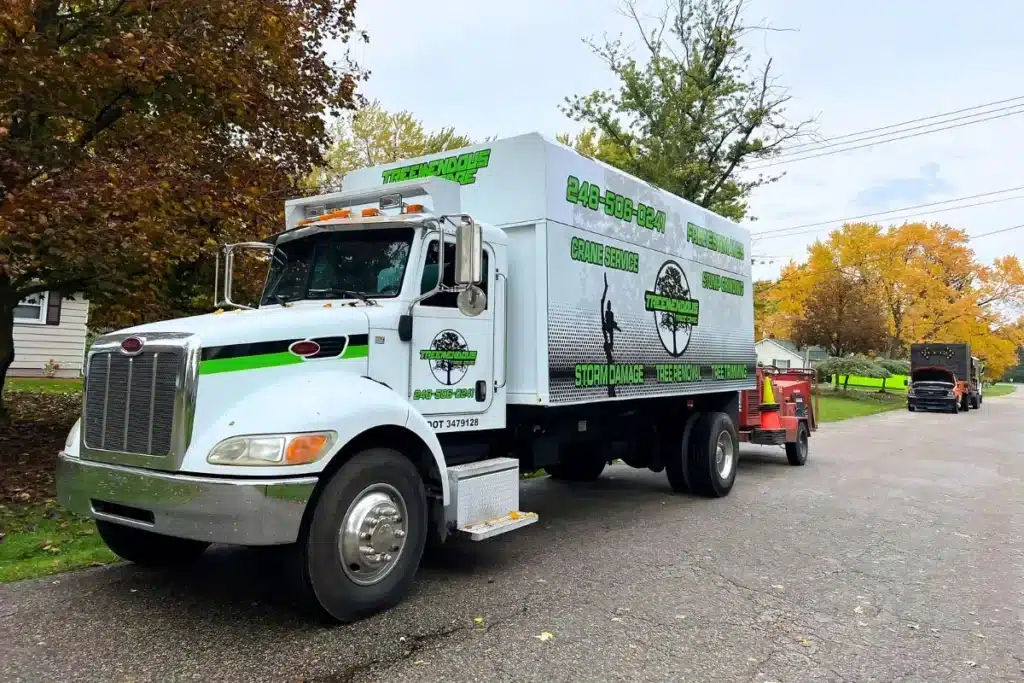
We always strive to educate our clients while providing tree-care services. This will help ensure you feel confident that you’re getting the kind of service that you deserve.
Contact us today and see this in practice — Treemendous Tree Care has been helping homeowners take care of their trees since 2019. Whether you’re in Macomb Township, Warren, Fraser, or anywhere else in Southeast Michigan, we’d love to provide the arborist guidance and tree care you need.
Contact us today to get started.