Skip to content
Pine trees are incredibly important components of Michigan’s commercial properties, residential lots, and forests. They not only provide environmental benefits ranging from erosion control to wildlife habitat, but they also provide humans with a number of benefits, including reduced summer temperatures, increased property values, and aesthetic charm.
But while they’re usually hardy trees, pines do occasionally suffer from problems that, if not addressed, can cause them to decline or die. To help you better understand your pine trees, we’ll share some of the most important things homeowners and property managers need to know below.
Michigan’s Pine Tree Species
To begin, it’s important to familiarize yourself with the pine trees that are common in Michigan – and this includes both those species that are native to the state as well as the non-native species that are commonly planted here.
Native Michigan Pine Species
Three pine tree species are native to Michigan:
- White Pine (Pinus strobus): Michigan’s state tree, the white pine is a large tree, reaching up to 180 feet or more in height. The white pine is easy to recognize by noting the regular branching pattern moving up the trunk, as well as its needles, which are in bundles of five.
- Red Pine (Pinus resinosa): Most common in the northern portions of Michigan, the red pine is another large species, that reaches about 100 to 120 feet in height. The red pine has chunky reddish-orange bark covering the upper trunk, and it has brittle needles grouped in bundles of two.
- Jack Pine (Pinus banksiana): The jack pine is smaller than either of Michigan’s other two native pines, and it rarely exceeds 70 feet in height. You can identify it by noting its very short (less than 2 inches long) twisted needles and scraggly, irregular shape.
Common Non-Native Pine Species in Michigan
In addition to Michigan’s three native species, there are at least five other species that are commonly planted in our area:
- Scots Pine (Pinus sylvestris): Native to a large portion of Europe and Asia, the Scots pine (which is sometimes called the Scotch pine) reaches about 115 feet in height. You can identify it by noting the very distinctive peeling orange bark on the upper trunk and its sparse crown.
- Austrian Pine (Pinus nigra): A large pine that’s native to isolated portions of Southern Europe, the Austrian pine is quite variable in appearance. But you can usually identify the species by noting its dark grey to black bark and long, dark green needles that are bundled in groups of two.
- Mugo Pine (Pinus mugo): Another European species, the mugo pine is also known as the dwarf mountain pine. Rarely exceeding 20 feet in height, you can ID this species by its small stature, short needles (in bundles of two), tiny cones, and bush-like growth habit.
- Japanese Black Pine (Pinus thunbergii): A tree hailing from South Korea and Japan, the Japanese black can reach more than 100 feet in height, but rarely does in Michigan. Relatively unlikely to be confused with any other pines, this tree has long, stiff, and shiny needles, which are dense at the ends of the branches.
- Ponderosa Pine (Pinus ponderosa): A gigantic pine from the American West, the ponderosa pine may exceed 200 feet in height in some cases. The needles of this tree may be grouped in clusters or two or three, and they smell of vanilla when crushed in the hand.

How to Care for Your Pine Trees: A Michigan Homeowner’s Guide
Fortunately, pines are generally hardy trees that don’t require the kind of intensive maintenance that some other species do — that’s actually a significant part of their appeal. However, there are still a few things you’ll want to do to give your pines the best chance of thriving, looking their best, and living a long life.
Plant the Right Tree in the Right Space
If you are considering adding new pine trees to your property, be sure to carefully select the planting location. This means ensuring that the space provides enough space for the tree at maturity and also that the space receives sufficient sunlight (virtually all pines require full sun exposure).
You’ll also want to consider the species-specific requirements and tolerances when identifying a planting location. For example, don’t plant a white pine near the road, as it won’t be likely to tolerate the salt spray that commonly affects roadside trees.
Apply a Layer of Mulch
Applying mulch under the canopy of a pine is one of the most beneficial steps homeowners and property managers can take to ensure the long-term health of the tree. Ideally, you’ll want to add a 2- to 4-inch-thick layer of organic mulch under the tree, extending all the way to the dripline (the edge of the canopy).
However, do not allow much to physically contact the trunk – leave several inches of space between the mulch and the bark. This is important because the mulch will trap moisture, pests, and fungi near the trunk, which may cause problems with decay.
Provide Supplemental Water When Appropriate
Mature, established pines can usually obtain all of the water they need without help (the only exception to this is during extended summer droughts, when they do need some extra water). On the other hand, young and recently transplanted pines should always receive supplemental water.
In both cases, it’s important to provide the water in the proper manner. Don’t provide frequent, shallow irrigation, as this encourages the production of surface roots. Instead, give your pines a slow, deep, and thorough watering about once per week to help reduce drought stress.
Fertilize Only When Needed
Pines don’t usually require fertilization when planted in suitable locations. However, many urban and suburban lots are characterized by thin, low-quality soil, which means the trees may struggle to obtain the macro and micronutrients they need to thrive.
However, you don’t want to just apply fertilizer haphazardly; this can cause more harm than good. You’ll want to start by having a soil analysis performed so that the proper type of fertilizer can be selected to address the specific deficiencies present.
Monitor Your Trees’ Health
There’s one additional thing you need to do for your pines: Monitor their health and watch for signs of pests, damage, or disease. This is important as your trees will be much more likely to recover if you obtain care promptly.
So, always contact a professional arborist immediately if you notice any issues.
Trimming Pine Trees in Michigan
Pines rarely require structural pruning in the way that oaks, maples, elms, and other hardwoods may. In fact, pines don’t even tolerate heavy pruning well, and it can lead to decay setting in. With that said, pruning may be required to remove any dead, diseased, or damaged limbs. This is not only important for stopping the progression of pests or disease, but also to limit the risk presented by dangerous branches.
However, proper pruning techniques are required to help encourage the tree to compartmentalize properly (“compartmentalization” essentially refers to the process by which trees seal up damaged areas to prevent the spread of decay). Accordingly, given the fact that pruning is very dangerous work, it is always advisable to leave this kind of work to professionals.
If you suspect that your pines need to be trimmed, contact the professionals at Treemendous Tree Care immediately.

Common Pine Tree Problems in Michigan
While pines are generally hardy trees, they can suffer from a variety of problems in Michigan. Be sure to contact Treemendous Tree Care immediately if you notice any of the following diseases or problems:
- Diplodia Tip Blight: Caused by the fungus Diplodia sapinea, this disease most commonly affects Austrian pines, but it can also affect Scots and red pines. Diplodia tip blight causes new shoots to turn brown and die, and it may also cause black fungal fruiting bodies to appear.
- Sphaeropsis Canker: Caused by the same fungus as Diplodia tip blight, this disease attacks the stems and branches of Austrian and red pines. It causes sunken cankers to form on the trunk and branches, as well as general dieback throughout the crown.
- Pine Wilt Disease: A fatal disease affecting nonnative pines such as Scots, Austrian, and mugo, this disease is caused by a native nematode (Bursaphelenchus xylophilus). The primary symptoms are sudden browning and death, which can occur in as little as a few weeks.
- Lophodermium Needle Cast: A fungal disease that often affects Scots, red, and Austrian pines (especially those in humid areas), this disease causes the needles to turn yellow or brown and fall prematurely. Black fruiting bodies will often develop on the fallen needles.
- Dothistroma Needle Blight: Common in Austrian, red, and ponderosa pines, this fungus causes banded brown lesions on needles to form. Shortly after infection occurs, the tree’s needles may start to break off and drop to the ground.
- White Pine Blister Rust: Caused by the fungus Cronartium ribicola, white pine blister rust has a complex lifecycle with requires Ribes species (currants and gooseberries) growing nearby to complete its lifecycle. Infected limbs typically display yellow or brown needles.
- Armillaria Root Rot: A slow-developing fungal disease that causes crown thinning and dieback, Armillaria infections are often discovered by noting honey-colored mushrooms at a tree’s base. Because the roots are compromised by this fungus, removal is often required.
Signs Your Pine Tree May Require Removal
Unfortunately, pines may succumb to pests, pathogens, or physical damage that can leave them unstable or hazardous. And in these cases, it is often wise to have the tree removed and replaced with a new, healthy tree. You’ll need a professional arborist to determine exactly when a pine tree requires removal, but the following signs and symptoms are often concerning:
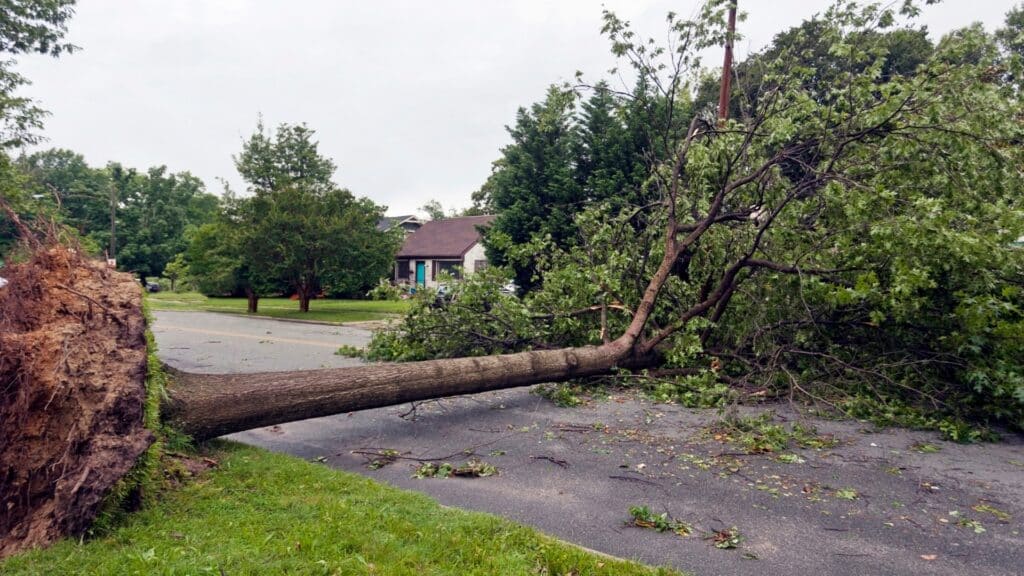
- Sudden Lean: Trees that have developed a lean over many years or decades can often be stable, having built enough response wood to accommodate the unusual loads they’re under. But trees that begin leaning suddenly are often very hazardous and should always be inspected immediately.
- Mounding Soil: Mounding soil commonly occurs when a tree’s root system starts failing or the soil loses its ability to properly anchor the tree. As with sudden leans, this is an emergency situation that requires immediate assistance from a tree-care professional (ideally, one who can provide crane-assisted removal).
- Large Cracks: Cracks indicate that a tree’s structural integrity has already been compromised, and the tree is at high risk of failure. If you notice a significant crack in one of your pines — particularly a horizontal crack — stay clear of the area and contact Treemendous Tree Care immediately.
- Branch Dieback: Branch dieback is not always a death sentence for a tree, but it is always cause for concern. A variety of different pests and diseases can cause branches to die back, so you’ll want to have the tree assessed by a professional arborist immediately.
- Large Hollows: Large cavities and hollows are great for wildlife, but they often spell serious trouble for the tree. Most large hollows are associated with significant decay, and they usually reduce a tree’s structural stability to some extent.
- Mushrooms or Conks: Mushrooms and conks are considered definitive indicators of decay. If the decay is occurring in the dead heartwood, the tree may not require immediate removal, but sapwood decay is often a very serious problem that necessitates prompt action.
If you notice any of these signs, contact the professionals at Treemendous Tree Care immediately.
Treemendous Tree Care: Providing Pine Tree Care in Clinton Township, MI
It’s always important for homeowners and property managers to establish a relationship with a high-quality tree-service team. This not only means you’ll know who to call in the case of a tree-related emergency, but it can also help you give your trees the proactive care they need to thrive.
Whether you’re in Warren, Mount Clemens, Chesterfield Township or anywhere else in Southeast Michigan, we’d love to help provide the tree services you need. Contact us today to have a tree inspection or obtain a free estimate for any pruning, removal, or stump-grinding tree services you may require.