Skip to content
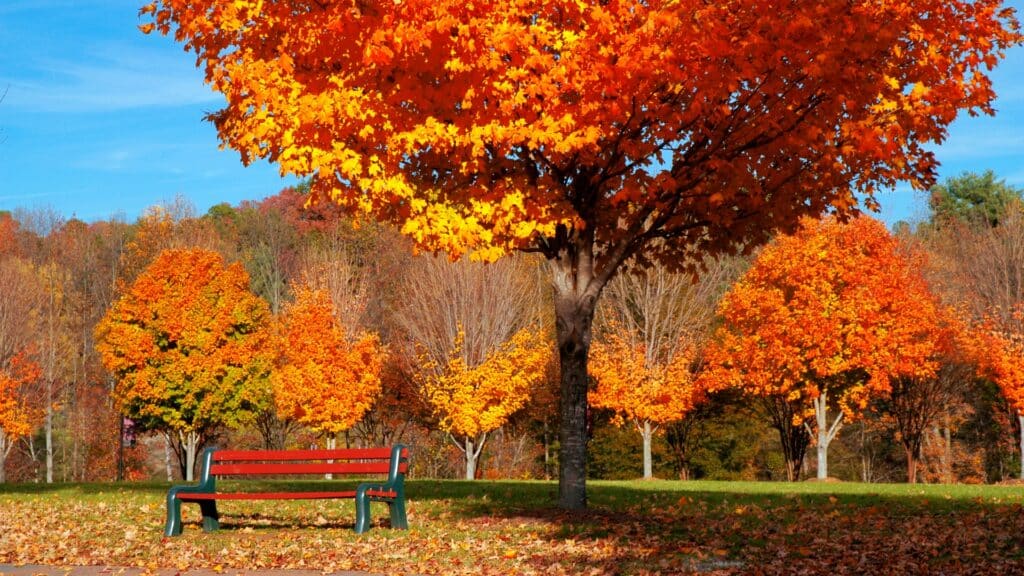
Maples may be the most beloved trees in the entire state of Michigan. From the dense summer shade they provide to their spectacular fall color, there are a number of things to love about these special trees.
But whether you have mature maples growing in your backyard or you’re considering adding a few saplings alongside your driveway, it’s important to familiarize yourself with the maple tree basics, so you can give them the best chance of thriving.
We’ll try to help you do exactly that below, by outlining some of the most common maples in Michigan, identifying some of the most common problems they face, and sharing a few care tips you’ll want to employ.
Michigan’s Maple Tree Species
While there are some disputes about the taxonomy of Michigan’s maples, and authorities occasionally reach different conclusions, most tree experts agree that 15 different maple species are commonly encountered in the state.
Native Michigan Maple Species
Eight different maple species grow naturally in Michigan. Because these species have adapted to our state’s climate, geography, and ecology across the eons, they tend to thrive in our region and often make great additions to properties.
- Sugar Maple (Acer saccharum): The sugar maple is one of our region’s most beloved and valuable hardwoods. The sugar maple thrives in rich, well-drained soils and produces brilliant orange-red fall color. It’s often a very hardy, resilient tree, but it can be sensitive to drought, soil compaction, and urban stress.
- Black Maple (Acer nigrum): The black maple is typically found in moist bottomlands, and it tolerates wetter soils and less sunlight than some other maples. It’s actually a close relative of the sugar maple, and many people have trouble distinguishing the two species. However, it has drooping, slightly hairy leaves, which serve as an ID clue.
- Red Maple (Acer rubrum): One of Michigan’s most adaptable trees, the red maple can grow nearly anywhere, from swamps to ridges. Prized for its vibrant red fall foliage, the red maple’s fast growth rate makes it a common street tree in our state. However, it has weak wood and produces surface roots that can cause issues.
- Silver Maple (Acer saccharinum): A fast-growing, flood-tolerant species common along rivers and urban sites, the silver maple has deeply lobed leaves with silvery undersides. It’s valued for shade and adaptability but prone to weak branch structure, hardwood and sapwood decay, and storm damage.
- Mountain Maple (Acer spicatum): A small, shrubby species native to northern Michigan’s cool forests, mountain maple often forms part of the understory on rocky or moist slopes. It provides wildlife browse and erosion control, but rarely grows large enough for timber or canopy value.
- Striped Maple (Acer pensylvanicum): Recognized by its smooth green bark with beautiful vertical stripes, the striped maple is a shade-loving understory tree found in mature hardwood forests. It thrives best with cool, moist habitat conditions, but it occasionally pops up in suburban locations.
- Ash-Leaf Maple (Acer negundo): Also called boxelder, this is a fast-growing, short-lived maple with compound leaves that resemble ash foliage (hence its common name). This maple tolerates drought and poor soils, but it is often considered undesirable, thanks to its weak wood and unkempt-looking silhouette.
- Freeman Maple (Acer × freemanii): A naturally occurring hybrid between red and silver maples, the Freeman maple is widely planted in Michigan landscapes under cultivars like ‘Autumn Blaze’ and ‘Jeffersred.’ It performs well in urban settings but can still develop weak branch unions if not properly pruned when young.
Common Non-Native Maple Species in Michigan
In addition to our state’s native species, seven non-native maples are commonly planted in our region. Some of these are welcome additions to properties and rarely spread invasively through the surrounding habitats. Others, however, are more problematic and aren’t necessarily good options for Michigan properties.
- Amur Maple (Acer ginnala): A small ornamental tree or large shrub from northeastern Asia, the Amur maple is valued for its bright red fall color and tolerance of cold. It frequently escapes cultivation in Michigan and is now listed as a restricted invasive due to its ability to outcompete native vegetation.
- Norway Maple (Acer platanoides): Introduced from Europe as a hardy street tree, Norway maples form a dense canopy that provides homeowners with deep shade, but this also prevents native understory plants from thriving around it. Because it produces a prolific number of seeds, it’s somewhat invasive in Michigan.
- Japanese Maple (Acer palmatum): A slow-growing ornamental species from East Asia, known for its deeply lobed leaves and elegant form, the Japanese maple is available in hundreds of colorful cultivars. It’s non-invasive and highly prized in landscaping, but it’s sensitive to cold, wind, and salt in our region.
- Tatarian Maple (Acer tataricum): Native to southeastern Europe and western Asia, this small tree is closely related to the Amur maple and often hybridizes with it. It’s both hardy and drought-tolerant, but it can self-seed aggressively in disturbed sites and presents some ecological problems when not managed.
- Sycamore Maple (Acer pseudoplatanus): A large, long-lived species from Europe with broad, coarse leaves and mottled, peeling bark, this species superficially resembles the American sycamore. It’s occasionally planted as a shade tree, but it can naturalize and spread in moist or coastal areas.
- Paperbark Maple (Acer griseum): A slow-growing ornamental tree from central China, the paperbark maple is prized for its peeling, cinnamon-colored bark and trifoliate leaves (each leaf features three leaflets). It remains small and non-invasive, and it’s commonly used as a specimen tree in arboretums and designed landscapes.
- Hedge Maple (Acer campestre): A compact European species that’s tolerant of pollution, heavy pruning, and urban soils, the hedge maple is widely planted as a small street or courtyard tree in Michigan cities. It’s a nice tree, but its fall color is modest at best.

How to Care for Your Maple Trees: A Michigan Homeowner’s Guide
No matter what maple species you have growing on your property, you’ll need to provide them with proper care. That generally means doing the following:
- Planting the right tree in the right space. You obviously can’t (easily) move an existing, established tree to a new location, but if you’re installing new maples on your property, you’ll want to pick a good spot for them. That means selecting an area with things like proper sun exposure, drainage, and clearance.
- Mulching your trees properly. Almost all trees will benefit from having their root zone covered with a 2- to 4-inch-thick layer of organic mulch. This not only helps retain soil moisture and protects the roots from temperature extremes, but it also protects them from mower damage and improves soil structure.
- Providing additional water when necessary. It’s always important to provide supplemental irrigation for several weeks (and potentially longer) after installing new trees, and it can also be important to do so for established trees during droughts. Use a soil moisture meter to help keep an eye on your trees’ water needs.
- Applying fertilizer when deficiencies occur. While fertilizer is often overused, it can be helpful (and occasionally necessary) for helping trees grow properly. But always use an organic, slow-release fertilizer and only do so after having the soil tested to determine the specific deficiencies present.
- Monitoring your trees regularly. Unfortunately, a lot of tree problems go unnoticed until it’s too late to take corrective actions. So, be sure to inspect your trees regularly for signs of leaf disease, large cracks, or fungus growing around the roots. Ideally, you’ll have a professional arborist inspect them once per year.
Pruning Maple Trees in Michigan
Young, newly established maples should be pruned about two to three years after they’re planted to help promote good structure and proper branching habits. Mature maple trees will also require periodic pruning (generally once every three years or so) to remove dead wood and ensure proper structure.
Homeowners and property managers can handle structural pruning while a tree is young, if they’re willing to learn the proper techniques. However, mature maples should only be pruned by professionals, as the safety risks involved are quite significant.
Nevertheless, whether you’re pruning maples yourself or having a professional do so, here are a few of the most important aspects of pruning maples:
- Timing: Generally speaking, maples should only be pruned in the late winter to early spring, when they’re dormant, and sap flow levels are minimal. This helps prevent the heavy sap “bleeding” that can occur during the late spring or early summer.
- Purpose: Pruning should only be carried out to reduce safety risks, remove dead wood, or provide additional clearance (and that should only be carried out when absolutely necessary). Every pruning cut is a wound that’ll expose the tree to pests and decay, so it’s not something to take lightly.
- Technique: All pruning cuts should be placed in the appropriate locations, and the three-cut method should always be used when removing large limbs. This can help prevent the tree from stripping large pieces of bark from the large limbs and trunk of the tree.
- Tools: Proper tools, including sharpened chainsaws and professional-caliber loppers or handsaws, should always be used to prune maple trees. This helps ensure that the cuts are all made cleanly and don’t damage the surrounding tissues or leave frayed edges.
It does bear mentioning that professional arborists may occasionally find it necessary or advisable to bend these rules on a case-by-case basis. But homeowners and property managers should generally stick to these guidelines.
Common Maple Tree Problems in Michigan
Unfortunately, maple trees are susceptible to a variety of problems in our state. Some can be treated, but you’ll need to move quickly to give them the best chance at a full recovery.
A few of the most important maple tree problems in Michigan include:
- Tar Spot (Rhytisma spp.): A fungal leaf disease that causes raised black, tar-like spots on leaves. Tar spot most commonly affects Norway, silver, and red maples. It’s unsightly but harmless. You simply need to rake and remove fallen leaves to reduce reinfection.
- Anthracnose (Discula, Kabatiella, Gloeosporium spp.): Anthracnose causes irregular brown lesions along the leaf veins and occasionally triggers early leaf drop, especially during cool, wet springs. It’s usually not serious, though repeated infections can weaken trees. Having it pruned to increase airflow will often help.
- Verticillium Wilt (Verticillium dahliae): A soilborne fungus that clogs the tree’s vascular tissue, verticillium wilt usually causes wilting or dieback in one section of the crown. Cross-sections taken from infected trees often reveal greenish-brown streaking in the sapwood. There’s unfortunately no cure, and removal is often necessary.
- Girdling Roots: Girdling roots are named for their habit of circling the trunk or other roots and preventing water and nutrient transport. They’re most common in trees that are planted too deeply or raised in containers of insufficient size. Air-spading and selective root removal can sometimes correct the issue and restore health.
- Sapstreak Disease (Ceratocystis virescens): A wound-related fungus that infects sugar maples, it infects trees through root or lower trunk injuries. It causes upper crown dieback and brown streaking in the wood near the tree’s base. Prevention is the only real defense; it’s not easy to treat once infection occurs.
- Leaf and Twig Insects (aphids, scale, mites, borers): Common pests like leafhoppers, maple bladder galls, and petiole borers cause minor aesthetic damage to maples. More troubling pests, such as scale and borers, may lead to dieback if the infestations are heavy. Fortunately, many pests can be treated when necessary.
- Frost Cracks & Sunscald: Caused by rapid winter temperature swings, frost cracks and sunscald are most common on south- or west-facing trunks. You’ll see long vertical cracks or discolored bark patches in affected trees. There isn’t really any treatment for these issues, but minor cases don’t usually cause serious problems.
- Sooty Mold: A black, sticky coating that develops on leaves beneath sap-feeding insects like aphids and scale, sooty mold doesn’t usually harm the tree, but it does indicate an underlying pest issue. Control the insects, and the mold will fade naturally.

Signs Your Maple Tree May Require Removal
Unfortunately, some maple trees will become diseased, pest-ridden, damaged, or otherwise hazardous and require removal. So, keep an eye out for the following issues. If you notice any of these problems, be sure to contact an arborist immediately.
- Mounding Soil: One of the most troubling warning signs, mounding soil near the base of a tree (often on one side) can indicate that the soil or roots are actively failing. Keep everyone away from these kinds of trees and contact an arborist immediately.
- Large Hollows: Large tree hollows are typically a troubling sign that indicates decay is present inside the tree. Hollows compromise the structural integrity of a tree, so it’s important to have them assessed by an arborist promptly.
- Prior Limb Drop: Unfortunately, trees that have dropped limbs in the past are more likely to shed additional limbs in the future. This isn’t always an issue if a tree is only dropping small, dead limbs (that’s normal); but if your tree has shed large, live limbs, you’ll want to have it inspected.
- Significant Cracks: Cracks are another sign that often indicates a tree is already failing. However, there are a few techniques (such as cabling and bracing) that may prevent the crack from growing and keep a tree safe enough to retain.
- Narrow Branch Junctions: Narrow branch junctions are often weak, especially if they contain included bark (bark that’s trapped between the wood of each branch). Unfortunately, maples often exhibit narrow unions that lead to branch failure.
- Mushrooms or Conks: Mushrooms, conks, and other types of fungal activity are always a concerning sign, as they can indicate the presence of advanced decay inside the tree or root system. Not all tree fungus will necessitate the removal of the tree, but it’s important to have such trees inspected by a professional.
- Sudden Lean: Not all leaning trees are hazardous; some will lean because they’re trying to reach more sunlight or growing on a hill. But these kinds of leans develop slowly, over the course of years or decades. Sudden leans, however, are an emergency issue — keep people away from the tree and contact an arborist immediately.
- Crown Dieback: Trees that begin losing leaves in their crown may be suffering from pest issues, vascular diseases, or a number of other ailments. This can be especially concerning if it occurs across a large percentage of the canopy, so always monitor your tree’s canopy through the spring, summer, and fall.
- Insect Activity: Not all insects are stressful for trees, and even some that regularly feed on leaves or sap are essentially harmless. But some other insects are quite destructive, potentially even fatal for the tree. The earlier you have these kinds of problems addressed, the more likely your tree will recover.
Treemendous Tree Care: Providing Maple Tree Care in Clinton Township, MI
Whether you have a yard full of native maples or a single Japanese ornamental, the professional arborists at Treemendous Tree Care can help provide the care they need to continue thriving for years. From tree trimming and arborist inspections to removals and stump grinding, we offer all of the tree-care services residents and property managers in Clinton Township, Michigan need.
Contact us today to schedule your free on-site estimate and see the Treemendous Tree Care difference for yourself!
Sources and References
- Arboriculture & Urban Forestry – “The Influence of Decay on the Static Load-Carrying Capacity of Red Maple”
Peer-reviewed ISA publication analyzing how internal decay affects the mechanical strength and stability of Acer rubrum (red maple) trees, offering insight into decay detection and structural assessment for arborists.
https://auf.isa-arbor.com/content/isa/22/6/249.full.pdf - Michigan Society of American Foresters – “Michigan Maples”
Overview of Michigan’s native and introduced maple species, their identifying characteristics, ecological roles, and value to forests and landscapes across the state.
https://msaf.forest.mtu.edu/ForestInfo/Newspaper/070-0304.htm - Michigan State University Extension – “Going Native with Michigan Trees”
Educational guide encouraging the use of native Michigan trees in landscaping for biodiversity, habitat value, and long-term ecosystem health.
https://www.canr.msu.edu/news/going_native_with_michigan_trees - Michigan Nature Guy – “Michigan Maples”
Field-oriented blog post profiling each maple species found in Michigan, including native and exotic varieties, with emphasis on identification, range, and natural history.
https://www.michigannatureguy.com/blog/2019/08/14/michigan-maples/ - Bonap/Biodiversity of the Eastern United States – Acer Species Database Entry
Plant database profile for Acer species providing range maps, taxonomy, and native/exotic status across the United States, with specific data relevant to Michigan’s maple species.
https://bplant.org/plant/8521