Skip to content
Imagine a tree so wide it takes five adults, arms outstretched, to circle its trunk. Or one that was already growing centuries before Michigan became a state.
Both are part of Michigan’s living history. From towering white pines in the northern forests to enormous oaks hiding in plain sight near bustling cities, the Great Lakes State is home to some extraordinary trees.
Here are nine of Michigan’s biggest, oldest, and most remarkable trees — and what helps giants like these stand the test of time.
Identifying the “Biggest” and “Oldest” Trees
There’s no single definition of a “big” tree. Michigan’s official big tree register scores trees with a point system that adds trunk circumference (in inches), height (in feet), and one-quarter of the average crown spread (in feet).
Age is another measure entirely, and it’s often an estimate. Without reliable historical records or a tree-ring count, ages are generally inferred from a tree’s size, species, and known history.
Michigan’s 9 Biggest & Oldest Trees
The nine trees below earn their spots on our list through exceptional size, age, champion status, or some combination. They’re arranged as a road trip from the southwest corner of the state to the tip of the Keweenaw, not as a ranking.

Map Legend
🌳 🌲 Public access — Trees and forests open to visitors
🔒 Private property — Approximate locations only; not open to visitors
🌲 Protected habitat (black marker) — Fayette’s ancient cedars; view from the water only
Map markers for trees on private property indicate approximate locations only, not exact addresses. Please respect property boundaries and posted access restrictions.
1. The Old-Growth Giants of Warren Woods, Three Oaks
Species: American beech (Fagus grandifolia), sugar maple (Acer saccharum), and more
Location: Warren Woods State Park, Berrien County
Claim to Fame: Michigan’s last known virgin beech-maple forest
Can You Visit? Yes, with a state park pass
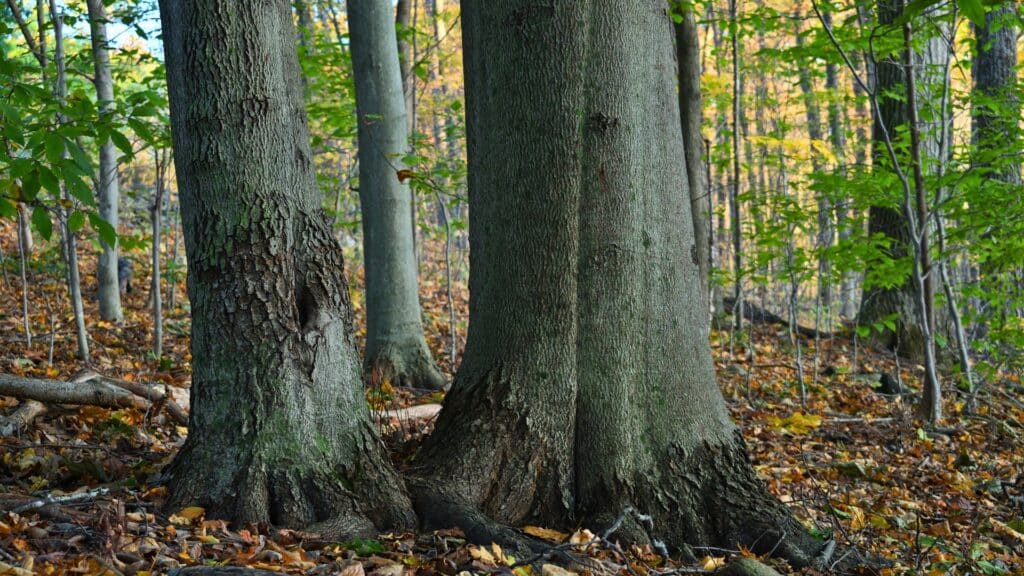
Start your tour among some of Michigan’s last remaining old-growth beech-maple trees. Warren Woods preserves Michigan’s last known virgin beech-maple forest, where some trees exceed 5 feet in diameter and 125 feet in height.
The forest survived largely because Edward K. Warren began acquiring land here in 1879 and set it aside for preservation. Today, visitors can cross the Galien River and walk among old-growth beeches that offer a rare glimpse of the forests that once covered southern Michigan.
One beech recorded at Warren Woods is estimated to be about 275 years old — meaning it may have been growing for a century before Warren stepped in to protect the land.
Schedule your visit in late April or early May, when wildflowers carpet the forest floor beneath the giants.
2. The National Champion Bur Oak, Berrien County
Species: Bur oak (Quercus macrocarpa)
Location: Berrien County (exact address withheld)
Claim to Fame: The largest known bur oak in the United States
Can You Visit? No, it stands on private property
This is the only tree on our tour that holds a national title. Its trunk measures about 27 feet around, and its crown spreads 127 feet, wider than the tree is tall.
All told, it scores 448 points on the big tree register.
Bur oaks are built for the long haul. Their thick, corky bark helped them survive the prairie fires that once swept southern Michigan, and open-grown specimens like this one can develop enormous, sprawling crowns.
3. The Kalamazoo County American Elm
Species: American elm (Ulmus americana)
Location: Rural Kalamazoo County
Claim to Fame: One of the highest-scoring trees in the state
Can You Visit? No, it stands on private property
In the mid-20th century, Dutch elm disease devastated American elm populations across the Midwest. But this one not only survived, it thrived.
Remeasured in January 2026, this remarkable survivor earned 415 points on Michigan’s big tree register. Its trunk measures more than 23 feet around, while its massive crown spreads more than 142 feet across an open field in rural Kalamazoo County.
Standing alone, the elm is a striking reminder of the giants that once graced Michigan’s landscape before Dutch elm disease took its toll.
4. The Michigan Ross Bur Oak, Ann Arbor
Species: Bur oak (Quercus macrocarpa)
Location: University of Michigan’s Ross School of Business, Tappan Street
Claim to Fame: A tree that predates the American Revolution, and once took a ride down campus
Can You Visit? Yes, it stands on the school’s front lawn
This 65-foot bur oak is estimated to be roughly 250 years old, older than the university and the city of Ann Arbor.
In 2014, it stood directly in the path of a building expansion. But rather than cut it down, the university moved it. Crews lifted the tree and its massive root ball onto wheeled carts using inflatable air bladders, then moved it about 100 yards to its new home.
The move cost roughly $400,000, and the tree was relocated to the school’s front lawn.
5. The Elmwood Cemetery Elm, Detroit
Species: American elm (Ulmus americana)
Location: Historic Elmwood Cemetery, Detroit
Claim to Fame: A roughly 250-year-old survivor in the heart of the city
Can You Visit? Yes, the grounds are open to visitors
Dutch elm disease reached Detroit around 1950 and destroyed more than 100,000 of the city’s elms. But one giant on a rise at Elmwood Cemetery made it through.
Estimated at about 250 years old and roughly 110 feet tall, it may have been a sapling during the 1763 Battle of Bloody Run, fought on the very ground the cemetery now occupies.
Elmwood is also a certified arboretum with self-guided tree tours, so plan to linger. Its oldest tree, a bur oak, is estimated to be about 280 years old.

6. The Ancient Northern White Cedars of Fayette, Garden Peninsula
Species: Northern white cedar (Thuja occidentalis)
Location: Fayette Historic State Park, Delta County
Claim to Fame: Tiny, twisted cliffside survivors that have endured for more than 1,400 years
Can You Visit? The cliffs are closed to visitors, but you can view the ancient cedars from Lake Michigan by boat or kayak
Some of Michigan’s oldest living trees don’t look particularly impressive at first glance. Clinging to limestone cliffs above Lake Michigan, many of these northern white cedars are short, twisted, and weathered by centuries of harsh conditions.
Their appearance is deceiving.
Researchers have documented cedars in this cliffside ecosystem that are estimated to be more than 1,400 years old, making them among the oldest known trees east of the Rocky Mountains. Living on exposed cliffs protected them from logging, wildfire, and many of the disturbances that affect trees rooted in richer soils.
Because the cliffside habitat is ecologically sensitive, visitors can’t approach the ancient cedars on foot. Instead, you can glimpse these remarkable trees from Lake Michigan by boat or kayak. Bring a camera with a telephoto lens and look up — some of Michigan’s oldest living trees are easy to miss!
7. The Eastern White Pines of Hartwick Pines State Park, Grayling
Species: Eastern white pine (Pinus strobus)
Location: Hartwick Pines State Park, Crawford County
Claim to Fame: The tallest measured tree on our tour, it’s located in the Lower Peninsula’s largest old-growth pine stand
Can You Visit? Yes, via a paved, accessible trail
Before the logging boom, white pines like these covered much of northern Michigan. Today, Hartwick Pines protects 49 acres of old growth, with trees estimated at 350 to 400 years old.
One of its white pines has been laser-measured at about 165 feet, taller than any other tree on our tour. The park’s famous “Monarch” pine once stood 155 feet tall before it died in the 1990s, but plenty of giants remain along the 1.25-mile Old Growth Forest Trail.
It’s a fitting stop for Michigan’s state tree.
8. The Father Maple, Benzonia
Species: Sugar maple (Acer saccharum)
Location: Benzonia, Benzie County
Claim to Fame: A remarkable sugar maple estimated to be more than 350 years old
Can You Visit? No, it stands in a field on private land
This sugar maple, nicknamed the Father Maple, may have sprouted around 1670. Its age is estimated at 355 years, give or take 40.
If that estimate holds, it was growing before Detroit was founded in 1701. Its trunk measures about 16 feet around, though it may be several trunks fused together.
9. The Estivant Pines, Copper Harbor
Species: Eastern white pine (Pinus strobus)
Location: Estivant Pines Nature Sanctuary, Keweenaw County
Claim to Fame: One of the last and largest old-growth white pine stands in Michigan
Can You Visit? Yes, with no entry fee
End your tour near the tip of the Keweenaw Peninsula, where many white pines measure 3 to 5 feet in diameter and are estimated at 250 to 400 years old.
These trees nearly fell to logging in the late 1960s. A statewide fundraising campaign saved the first 200 acres in 1973, and the sanctuary has since grown to more than 570 acres.
Walk the Cathedral Grove loop, look up, and you’ll see what much of Michigan looked like before the lumberjacks arrived.
What Helps a Tree Live for Hundreds of Years?
Michigan’s giants didn’t get that way overnight. Each one benefited from good genetics, the right growing conditions, and a fair amount of luck over many decades.
You can’t control luck. But you can give the trees on your property better odds of a long, healthy life, by following a few key principles.
Plant The Right Tree in the Right Place
Longevity starts with a good match between the tree and its site. Species that live for centuries, like oaks and sugar maples, need room for both their roots and their crowns.
A tree crowded against a foundation or planted in poorly drained soil will spend its life struggling. When you plant, choose species suited to your soil, sunlight, and the space available at maturity.
Protect the Soil & Roots
Most of a tree’s roots live in the top foot or so of soil, often spreading well beyond the edge of its canopy. That makes them easy to damage without realizing it.
Soil compaction, trenching, grade changes, and construction near a tree can cut off water and oxygen to its roots. The damage often doesn’t show up for years, by which point the tree may already be in decline.
Remember the Ross bur oak? Moving it took months of careful preparation largely because protecting its root system was the whole ballgame.
Have Them Pruned by a Certified Arborist Periodically
Good structure is easiest to establish while a tree is young. Thoughtful pruning early on can prevent weak branch unions and competing leaders that cause trouble decades later.
On mature trees, less is often more. Removing dead, diseased, or hazardous limbs helps, but heavy cuts and topping create large wounds that invite decay.
Protect Them from Pests & Diseases
Michigan’s trees face no shortage of threats. Emerald ash borer has killed millions of the state’s ash trees, Dutch elm disease reshaped entire cities, and oak wilt continues to spread.
Oak wilt is worth special attention if you have oaks. Avoiding pruning or wounding oaks from spring through midsummer, when the beetles that spread the fungus are most active, is one of the simplest ways to protect them.
Monitor Them Regularly as They Mature
Mature trees can develop hidden decay, cracks, or weak limbs that aren’t obvious from the ground.
A periodic professional assessment can catch problems early, when there are more options for treating them. That might mean targeted pruning, cabling and bracing for heavy limbs, or simply peace of mind that your tree is in good shape.
Treemendous Tree Care: Helping Southeast Michigan Trees Thrive for Generations
You may not have a national champion growing in your backyard. But a mature oak, maple, or elm can be one of the most valuable features of your property.
The right care can help those trees stay healthy for decades to come. Our arborists help homeowners across Southeast Michigan with pruning, tree health care, risk assessments, and long-term management plans for valuable mature trees.

Contact Treemendous Tree Care today to schedule a professional evaluation of the trees on your property.
Sources & References
- Michigan Botanical Society – “Michigan Big Tree Program,” the state’s official big tree program, including its scoring system based on trunk circumference, height, and crown spread.
https://michiganbotanicalsociety.org/big-tree - Michigan Botanical Society – “Official Michigan Big Tree Register,” current measurements, point scores, and verification dates for Michigan’s champion trees, including the Berrien County bur oak and Kalamazoo County American elm.
https://michiganbotanicalsociety.org/big-tree-on-google - Michigan Department of Natural Resources – “Warren Woods Nature Study Area,” information on Michigan’s last known virgin beech-maple forest, its exceptional trees, and seasonal wildflowers.
https://www.michigan.gov/dnr/places/natural-areas/warren-woods-nature-study-area - Monumental Trees – “The Thickest, Tallest, and Oldest Trees in Michigan,” a volunteer-contributed database documenting notable trees, including measurements and estimated ages.
https://www.monumentaltrees.com/en/records/usa/michigan/ - Michigan Natural Features Inventory – “Bur Oak Plains,” information on Michigan’s historic oak savannas and the fire-resistant characteristics of bur oaks.
https://mnfi.anr.msu.edu/communities/description/10713/bur-oak-plains - University of Michigan Record – “Historic Ross School Tree Scheduled to Be Moved This Month,” the university’s account of the preparation and relocation of its historic bur oak in 2014.
https://record.umich.edu/articles/historic-ross-school-tree-scheduled-be-moved-month - Associated Press via CBS Detroit – “250-Year-Old Tree Moving to New University of Michigan Spot,” reporting on the Ross bur oak’s estimated age, relocation distance, and cost.
https://www.cbsnews.com/detroit/news/old-tree-moving-to-new-university-of-michigan-spot - Detroit Free Press via Yahoo News – “At Elmwood Cemetery, Is Time Running Out for a 250-Year-Old Tree?” reporting on the historic American elm’s age, health, and survival through Detroit’s Dutch elm disease epidemic.
https://news.yahoo.com/time-may-nearly-250-old-100149540.html - BLAC – “Sacred Earth at Elmwood Cemetery,” historical background on the cemetery, the Battle of Bloody Run, and its surviving American elm.
https://blac.media/stories/sacred-earth-at-elmwood-cemetery - Historic Elmwood Cemetery – “Tree Tours,” information on the cemetery’s arboretum, notable trees, and self-guided tours.
https://elmwoodhistoriccemetery.org/foundation/tree-tours - Northern Express – “Lose Yourself Among Hartwick’s Ancient Pines,” information on the park’s old-growth forest, ancient white pines, and accessible forest trail.
https://www.northernexpress.com/news/feature/lose-yourself-among-hartwicks-ancient-pines/ - Michigan Country Lines – “Hartwick Pines State Park: Evading the Axe,” historical context and information on the Lower Peninsula’s largest remaining old-growth pine stand.
https://www.countrylines.com/featured-2/hartwick-pines-state-park-evading-the-axe/ - Monumental Trees – “Sugar Maple ‘Father Maple’ Near the Mother Maple, Benzonia,” recorded measurements, estimated age, and location information for this notable sugar maple.
https://www.monumentaltrees.com/en/usa/michigan/benzie/14822_mothermaple/27880/ - Great Lakes Now – “The Catch: 1,400-Year-Old Trees,” reporting on ancient northern white cedars growing on limestone cliffs near Fayette and their remarkable longevity.
https://www.greatlakesnow.org/2022/08/16/the-catch-1400-year-old-trees/ - Michigan Department of Natural Resources – “Fayette Historic State Park,” official information on the park, its location, and visitor facilities.
https://www.michigan.gov/recsearch/parks/fayette - Old-Growth Forest Network – “Estivant Pines Nature Sanctuary,” information on the sanctuary’s centuries-old white pines, conservation history, and protected acreage.
https://www.oldgrowthforest.net/mi-estivant-pines-nature-sanctuary - Michigan Trail Maps – “Estivant Pines Nature Sanctuary,” visitor information, trail descriptions, and access to the Cathedral Grove.
https://www.michigantrailmaps.com/member-detail/estivant-pines-nature-sanctuary/ - Iowa State University Extension – “Tree Root Systems,” research-based guidance on the depth and spread of tree roots and the importance of protecting surrounding soil.
https://yardandgarden.extension.iastate.edu/article/1992/4-1-1992/treeroot.html - Michigan Department of Natural Resources – “Put That Saw Down! Delay Pruning Oaks Until Mid-July,” guidance on reducing oak wilt transmission by avoiding pruning during the high-risk season.
https://www.michigan.gov/dnr/about/newsroom/releases/2026/04/13/put-that-saw-down-delay-pruning-oaks-until-mid-july - Michigan Invasive Species Program – “Emerald Ash Borer,” official information on the invasive beetle and its devastating effects on Michigan’s ash trees.
https://www.michigan.gov/invasives/id-report/prohibitedrestricted/emerald-ash-borer - Michigan State University Department of Geography – “White Pine Logging: A Background,” historical information on Michigan’s once-abundant northern white pine forests and the extensive logging that transformed them during the 19th century.
https://project.geo.msu.edu/geogmich/loggingbackgrd.html