Skip to content
A mature tree is one of the best things a Southeast Michigan property can have. Many provide shade in the summer, serve as windbreaks in the winter, and increase curb appeal every season in between.
So, it’s understandable that most homeowners want to save a tree whenever possible. And in a lot of cases, they can.
But not every tree can be saved, and a struggling or damaged tree isn’t just a landscaping problem. A tree that’s structurally compromised is a safety risk to your home, your family, and anyone who walks underneath it.
The tricky part is that the difference between “this tree needs a little care” and “this tree needs to come down” isn’t always obvious to homeowners.
To help, we’ll share five signs that suggest a tree on your property may have crossed that line, along with what to check for and what to do if you spot them.
1. Large Cracks or Splits in the Trunk
A trunk is a tree’s main structural support, so a deep crack running through it is one of the more serious warning signs you can see.
But not all cracks are created equal. Some are superficial, and only affect the bark. Others extend into the wood and can affect the trunk’s structural integrity.
So, it can be difficult for homeowners to tell how serious a crack is from appearance alone. However, the following clues should prompt you to have the tree assessed by a professional arborist:
- A crack that’s new, growing, or widening, particularly after windy or icy weather
- A vertical crack running along a significant portion of the trunk or a large branch
- Any horizontal crack across the trunk or a main stem
- A crack you can see into, rather than a shallow surface split
- Sap, insect activity, or discoloration collecting in or around the crack
If you notice any of these, this isn’t the time to wait a month and see what happens. Have a professional take a look.

2. Extensive Deadwood or a Thinning Canopy
A few dead branches scattered through an otherwise healthy tree usually aren’t cause for alarm. Deadwood is a normal part of a tree’s life cycle, and it can often be corrected with routine tree pruning.
It’s a different story when deadwood makes up a large portion of the canopy, or when a tree that used to be full and green now looks noticeably thin and sparse. But while one dead branch doesn’t make for a dead tree, a canopy that’s getting thinner every year deserves a closer look.
Widespread dieback like this often points to a deeper problem, such as root damage, disease, or a decline that’s been building for longer than the visible symptoms suggest. Southeast Michigan homeowners have seen this with ash trees killed by emerald ash borer, which can become brittle after they die and begin dropping limbs as they deteriorate.
To ensure your tree remains safe, watch for the following signs:
- Bare, brittle branches that don’t leaf out in spring
- A canopy that’s noticeably thinner or more one-sided than in past years
- A steady buildup of small dead branches on the ground, even without recent wind
- Peeling bark or woodpecker activity concentrated on one tree
A tree in this condition may be more likely to drop large limbs without warning, and it’s worth having an arborist determine whether the tree can be saved or whether it’s beyond that point.
3. Mushrooms or Fungal Growth at the Base
Mushrooms, conks, or other fungal growth emerging directly from a tree’s trunk, root flare, or major roots can be a visible sign of internal decay. This kind of decay can be especially troubling when it occurs inside the roots or lower trunk, as it may affect the entire tree’s stability.
In other words, the mushroom itself isn’t necessarily the problem. What matters is what may be happening in the wood underneath it.
One example Southeast Michigan homeowners may encounter is Armillaria root rot, sometimes called shoestring root rot.
This fungus can produce clusters of honey-colored mushrooms around the base of an infected tree, along with significant decay in the roots and lower trunk. As that decay progresses, it can compromise the tree’s stability.
So, you’ll want to keep an eye out for the following signs and contact a professional arborist if you notice any:
- Shelf, bracket, or conk-shaped fungal growth on the trunk or exposed roots
- Clusters of mushrooms that repeatedly emerge from the same area of the trunk, root flare, or major roots
- Soft, spongy, or crumbling wood near the base
- White fungal growth beneath loose bark or other signs of decay near the root flare
When fungal growth is connected to wood, it may be causing damage farther inside the tree than you can see from the surface.
This is one of the harder signs to assess yourself, since the real extent of the damage may be hidden underground or inside the wood. That makes it a good reason to bring in a professional for a closer look.

4. A New or Worsening Lean
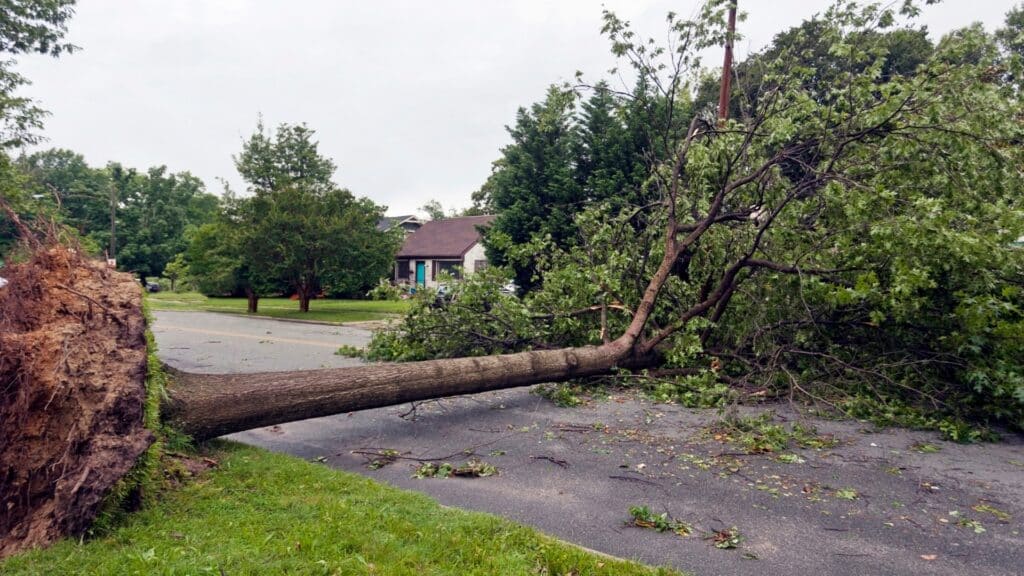
Some trees grow with a natural lean and remain safe for years. What matters here is change. A tree that’s leaned toward the garage for the last 20 years is one thing; a tree that started leaning toward it after last night’s storm is another.
If you see a tree with any of the following signs, it’s time to contact a professional arborist:
- Soil that’s cracked, mounded, or lifting on the side opposite the lean
- Exposed or snapped roots at the base
- A lean that developed within the last few weeks or months
- Cracks or gaps opening in the soil, lawn, or pavement around the trunk
Because root failure can mean the whole tree is at risk of coming down, a new or worsening lean is not a sign you’ll want to ignore.
5. Cavities or Hollows
Tree hollows are beneficial to wildlife, and they can be charming to look at in some cases, but they are not always a harmless phenomenon. Unfortunately, a large cavity can indicate internal decay that extends farther into the trunk than you can see.
However, that doesn’t mean every tree with a cavity needs to be removed, either. Some trees are able to compartmentalize decay, limiting its spread while continuing to produce new wood around the affected area. This can preserve the tree’s structural integrity for years.
Nevertheless, you’ll want to have a professional arborist assess your tree if you notice:
- A large or deep cavity in the trunk or a major limb
- Cavities near the root flare or in any major roots
- Animals repeatedly entering and exiting an opening in the trunk
- Small cracks with large amounts of smooth woundwood near their borders
That’s what makes cavities and hollows tricky: what you can see from the driveway may only be part of the story. A professional can evaluate the visible damage in the context of the whole tree and determine whether it can be managed or has become hazardous.
Not Every Damaged Tree Needs to Come Down
Seeing one of these signs doesn’t automatically mean a tree is a lost cause. Trees are resilient, and a lot of damage that looks alarming turns out to be manageable with the right care, whether that’s pruning, cabling, or simply monitoring the tree over time.
That’s exactly why a professional assessment matters.
An arborist can tell the difference between a tree that needs some attention and one that’s become a genuine hazard. That way, the decision about whether to remove a tree or not is based on what’s actually happening rather than a guess.

Common Questions About Signs of Trouble in Trees
It can certainly be alarming to notice mushrooms growing out of a tree root or see a tree begin to lean more than usual. And that naturally leads to questions. We’ll share answers to a few of the most common ones homeowners in Southeast Michigan ask our team below.
Do mushrooms kill trees?
Some fungi are pathogenic and attack living tree tissues, but many only break down wood that’s already dead. But even fungi that only attack dead wood can still compromise a tree’s structural stability.
That’s why it’s always a good idea to have a professional arborist assess any tree with fungal growth.
Why is my tree leaning?
Trees can lean for several reasons.
Sometimes they do because their root system is failing, the soil has lost its structural integrity, or both. They can also lean as a way of reaching more sunlight — something known as phototropism.
And while root or soil disturbances can create a hazardous situation, phototrophic growth doesn’t always indicate the tree is at risk for failure. That’s why it’s wise to have an arborist evaluate leaning trees, particularly if the lean has developed suddenly.
Should a tree close to a house be removed?
Not necessarily. Healthy, structurally sound trees can often be retained, but those that display the signs discussed above should be assessed by a professional arborist.
How can you tell if a tree is hazardous?
There are a number of signs that may indicate a tree is hazardous, including a new or increased lean, the presence of fungal fruiting bodies, or large cracks. But there are many other signs that may be concerning.
So, as a general guideline, it’s a good idea to contact a professional arborist if you notice anything out of the ordinary about your trees.
Can healthy trees be hazardous?
Absolutely. Tree health and structural stability are two entirely different things. Some healthy trees may fail completely if there are problems with the wood or soil, while even dead trees may not represent an immediate hazard in some cases.
Are tree hollows a sign of a problem?
They can be. Some tree hollows remain relatively small and contained, which prevents them from posing a significant risk. Meanwhile, other hollows may extend a considerable distance up and down the trunk, raising the risk of failure.
That’s why it’s always wisest to have a professional arborist evaluate any tree with a hollow or cavity.
Can every tree with cracks, hollows, or mushrooms be saved?
Not always, but spotting one of these signs doesn’t automatically mean removal, either. Some problems can be managed with pruning, cabling, or monitoring, while others indicate serious structural failure. That’s exactly why a professional assessment beats guessing from a list.

Get a Professional Tree Assessment in Southeast Michigan
If you’ve spotted one or more of these signs on your property, the safest next step is to request an assessment from the professionals at Treemendous Tree Care. We’ve been providing expert tree care services across Southeast Michigan since 2019, and we’d be happy to provide the guidance you need.
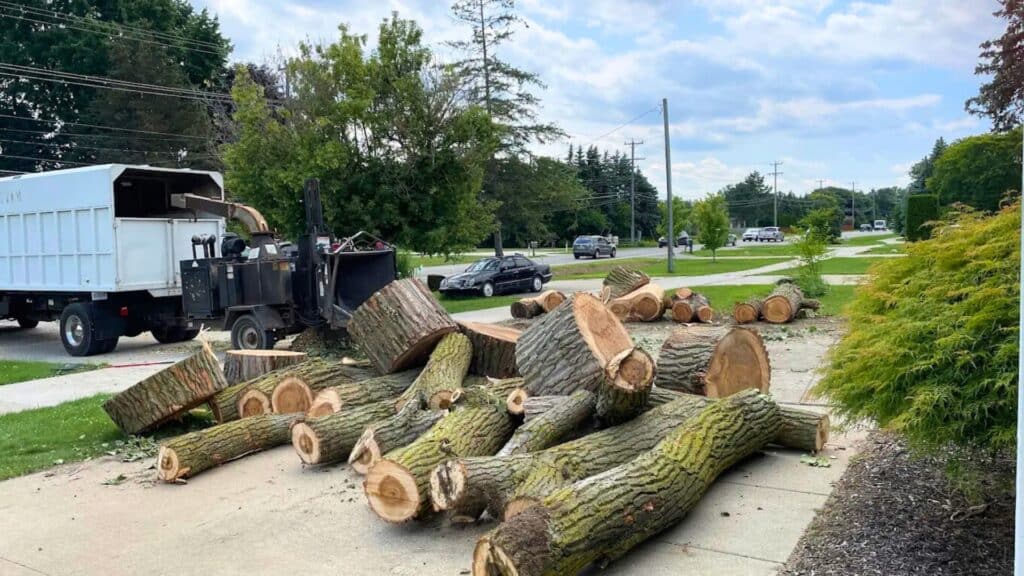
When tree removal is the right call, we handle it with the same care we bring to every job, using cranes and other specialized equipment to get the job done safely and protect the surrounding property. And if a tree on your property has already failed or become an immediate danger, our emergency tree service is available when you need help fast.
Contact us today to get started.
Sources & References
- Michigan State University Extension – “Dealing with Storm-Damaged Trees”
Helps homeowners assess damaged and declining trees to determine which can recover with care and which pose an ongoing safety risk.
https://www.canr.msu.edu/news/which_storm_damaged_trees_can_be_saved - Michigan Department of Natural Resources – “Make Safety a Priority When Cleaning Up Storm-Damaged Trees”
DNR release advising Michigan residents to have hazardous or storm-damaged trees evaluated and removed by a certified arborist or professional tree care company rather than attempting the work themselves.
https://www.michigan.gov/dnr/about/newsroom/releases/2025/05/16/make-safety-a-priority-when-cleaning-up-storm-damaged-trees - USDA Animal and Plant Health Inspection Service – “Emerald Ash Borer”
Federal profile of emerald ash borer (Agrilus planipennis), the wood-boring beetle responsible for widespread ash dieback and mortality across Southeast Michigan and beyond.
https://www.aphis.usda.gov/plant-pests-diseases/eab - Michigan State University Extension – “Armillaria Root Rot in the Great Lakes Region”
Explains the symptoms and signs of Armillaria root rot in Michigan and the Great Lakes region, including honey-colored mushrooms near the base of infected trees, white fungal growth beneath the bark, root decay, and branch dieback.
https://www.canr.msu.edu/news/armillaria_root_rot_in_the_great_lakes_region