Skip to content
Southeast Michigan weather can be hard on trees all year long. Powerful spring windstorms, summer thunderstorms, fall winds, and heavy winter snow and ice can all leave behind broken branches, split trunks, and fallen trees.
And unfortunately, some of these issues can require urgent attention from an arboricultural team that can restore safety to your property.
If you’ve already called for emergency tree service and removal, you’ve taken the most important first step. While you wait for the crew to arrive, there are a few things you can do to keep your family safe, protect your property, and help the cleanup go as smoothly as possible.
Assess the Damage from a Safe Distance
Start by looking at the big picture. You don’t need to walk underneath a damaged tree or tug on a hanging branch to figure out whether something is wrong. In fact, please don’t.
From a safe distance, look for:
- Hanging or partially detached limbs
- Large cracks or splits in the trunk
- A tree that has started leaning or leaning more than it did before
- Uprooted or exposed roots
- Soil that’s lifting or heaving around the base
- Broken branches lodged in the canopy
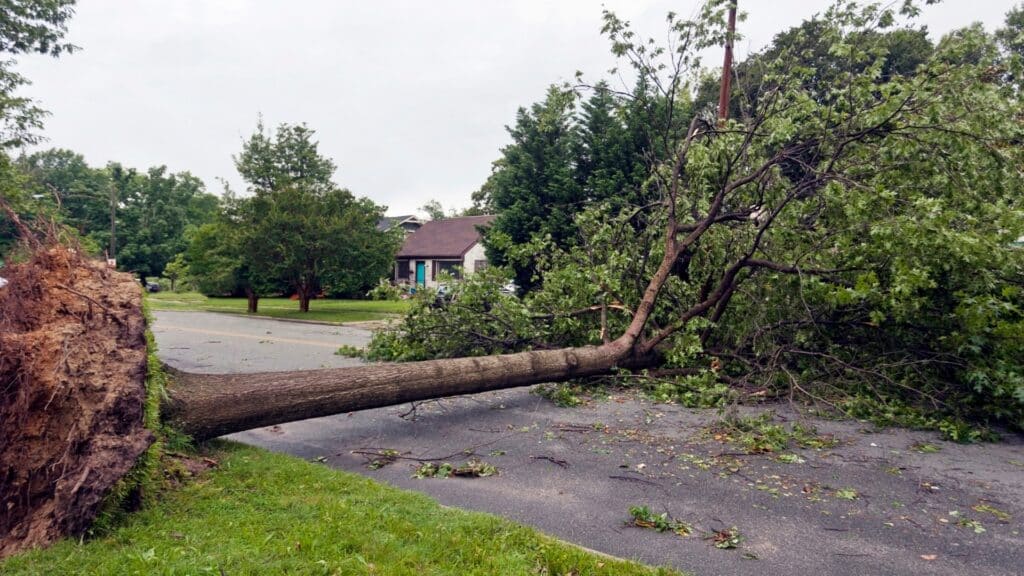
- Trees or large limbs resting on a house, garage, vehicle, fence, or other structure
Not all storm damage is as obvious as a tree lying across the yard. Cracks can develop where large branches meet the trunk, roots may loosen without pulling completely out of the ground, and damaged limbs can remain caught higher in the canopy.

Changes may also become more noticeable in the hours or days after a storm. If something about a tree looks different than it did before the weather moved through, point it out when the crew arrives.
The important distinction is to observe, not investigate.
Storm damage can change the way weight and tension are distributed throughout a tree.
A branch that appears to be securely caught in the canopy may not stay there. A leaning tree may have suffered damage to its root system that isn’t immediately visible. Even a tree that made it through the storm standing upright may have sustained structural damage.
Give anything questionable plenty of room and let the tree crew take a closer look.
Watch for Power Lines and Other Serious Hazards
If storm damage involves a power line, the priorities change immediately.
Never assume a downed line is safe because it isn’t sparking, smoking, or making noise. DTE Energy advises people to stay at least 25 feet away from downed power lines and treat every downed line as energized.
Don’t touch the tree or branch that’s contacting the line, and don’t touch a fence, vehicle, or other object that may also be in contact with it. Keep children and pets well away from the area, and report the downed line to your electric utility provider.
Most importantly, always call 911 if the situation poses an immediate threat to people or property.
Trees and large limbs resting on roofs or other structures also call for extra caution. They can shift as damaged wood settles, additional branches break, or weight moves through the tree.
You may be eager to see how much damage occurred. We understand. But this is one of those times when getting a closer look simply isn’t worth the risk.
Don’t Try to Remove Storm-Damaged Limbs Yourself
Picking up small twigs scattered across the lawn is ordinary yard cleanup and generally pretty safe. Cutting apart a storm-damaged tree is definitely not.
Broken and partially fallen limbs can be under significant tension. Cutting into them may cause the wood to spring, roll, split, or fall in a direction you weren’t expecting. A partially uprooted tree can also shift as branches are removed and its weight changes.
Dealing with these kinds of hazards requires considerable tree-care experience. But you also have to consider the tools required to do the job.
Chainsaws deserve respect on a perfectly ordinary day. Combine one with unstable wood, storm debris, poor footing, and branches overhead, and you’ve created a much more complicated situation. Adding a ladder to the equation doesn’t improve matters.
Simply put, storm cleanup is not the ideal time to channel your inner lumberjack.
Depending on the extent of the damage, the tree may only need professional pruning. In other cases, the trunk, root system, or overall structure may be compromised enough to make tree removal the safer choice.
Either way, leave the cutting for the crew. We have the equipment and experience to determine how to approach damaged wood without creating another hazard.

What You Can Do Before the Tree Crew Arrives
We’ve talked a lot about the things you shouldn’t do following a storm, but what about the opposite? What can you do?
Quite a bit, actually. A few simple steps can help protect everyone on the property and make it easier for your tree crew to get started when they arrive.
Keep People and Pets Away
Give the damaged tree plenty of space and make the area off-limits.
That includes children, neighbors who stop by to see what happened, and pets who have no idea why their usual backyard patrol route is now out of bounds.
If the damage affects a driveway, patio, sidewalk, play area, or another part of the property you normally use, find another route until the tree has been assessed.
Document the Damage
If you can do it safely, take photos or video of the tree and any property damage before cleanup begins.
Capture the overall scene as well as details you can photograph without approaching the tree. Those images give you a record of what the property looked like immediately after the storm and may be helpful if you need to speak with your insurance company.
The phrase “if you can do it safely” matters here.
Don’t walk underneath a hanging limb, climb onto a damaged roof, move branches, or enter an electrical hazard area to get a better picture. Your phone has a zoom function for a reason.
Make Access Easier
Tree work often requires more than a chainsaw and a pair of gloves. Depending on the job, the crew may need room for trucks, chippers, aerial lifts, cranes, or other equipment.
If you can do so without entering the hazard area, you can help prepare by:
- Moving vehicles away from the work area
- Unlocking gates
- Moving lightweight patio furniture or decorations
- Securing pets indoors
- Letting the crew know about narrow gates or other access limitations
- Pointing out septic systems, irrigation components, or other property features that may affect equipment access
There’s an important caveat: Don’t clear anything that’s underneath or immediately beside the damaged tree.
If making room requires walking into the hazard area or moving storm debris, leave it alone. We’ll determine how to access the site safely when we arrive.
What to Expect When Treemendous Tree Care Arrives
When we arrive at your Southeast Michigan property, we don’t start cutting right off the bat.
Instead, we’ll assess the tree, the surrounding property, and any hazards that could affect the work. Then we’ll determine the safest and most practical approach and explain what we recommend.
This is also a good time to share anything you noticed during or after the storm. If you saw the tree shift, heard a large crack, or noticed a new lean after the weather cleared, let us know. Those details can provide helpful context as we take a closer look.
Sometimes, a damaged tree can be preserved by removing broken or hazardous limbs. Other times, storm damage has compromised the tree enough that complete removal is the safest option.
Once we’ve addressed the immediate tree hazard, we’ll take care of the resulting debris and review the completed work with you.
A storm already made enough of a mess. Our job is to help you safely put things back in order.

FAQ: What Should You Do While Waiting for an Emergency Tree Crew to Arrive?
It’s natural to have questions while waiting for your tree-care company to arrive and start cleaning up the damage caused by the storm. After all, this is thankfully a relatively rare situation that most homeowners have never encountered.
To help, we’ll answer some of the most common questions homeowners have in this situation below.
What should I do if a tree falls on my house?
Start by ensuring that everyone remains safe. Stay away from the damaged area and don’t hesitate to leave the home if you feel that’s the best course of action.
After that, you’ll want to contact emergency services if appropriate (such as when an electric line is contacting your home or a tree), and then contact Treemendous Tree Care and request assistance.
What should I do if a tree or branch is touching a power line?
Never touch a branch or tree that is in contact with a power line. Stay at least 25 feet away and report the problem to your electric utility provider. Call 911 if the situation poses an immediate threat to people or property.
Is it safe to clean up fallen branches before the tree crew arrives?
You may be able to safely pick up very small sticks and twigs, provided they’re not located near a tree that has suffered damage. But in most other cases, it is wiser to simply wait for the tree crew to arrive.
Can I cut up a fallen tree myself?
Absolutely not. In fact, downed tree removal is one of the most dangerous tasks for tree-care professionals. Downed trees are often under tremendous tension, which can cause them to shift, snap, or spring in unpredictable ways.
Should I stay away from a storm-damaged tree even if it’s still standing?
Yes. It is always better to take a safety-first approach to potentially storm-damaged trees.
What should I do if a broken branch is hanging in a tree?
Broken branches that are lodged in the canopy can be very dangerous, so you’ll want to keep your distance and let the professionals handle it. There is a reason these are colloquially called “widow makers.”
Can a storm-damaged tree be saved, or does it need to be removed?
Some storm-damaged trees can certainly be saved, though others will present enough of a hazard to necessitate removal. One of our professional arborists can evaluate your tree and recommend an appropriate course of action.
Get Help with Storm-Damaged Trees in Southeast Michigan
The skies may have cleared, but a damaged tree can continue to pose a risk.
If you spot a hanging limb, cracked trunk, newly leaning tree, uprooted roots, or a fallen tree after severe weather, keep your distance. Safety comes before cleanup.
Treemendous Tree Care provides emergency tree service throughout Clinton Township and Southeast Michigan when the situation calls for professional help.
Whether you need hazardous limb removal, storm cleanup, fallen-tree removal, or help determining whether a damaged tree can be saved, we’re ready to assess the situation and recommend the next step.
Contact Treemendous Tree Care to schedule a free estimate and get help with your storm-damaged trees.

Sources & References
- DTE Energy — “Electrical Emergency”
Safety guidance for downed power lines, including staying at least 25 feet away, assuming downed lines are energized, and avoiding trees or other objects in contact with power lines.
https://www.dteenergy.com/us/en/residential/emergency-and-safety/emergency/electric-emergency.html - Michigan State University Extension — “Cleaning Up Damaged Trees After a Windstorm”
Guidance for safely assessing and cleaning up storm-damaged trees, including hanging limbs, unstable wood, downed power lines, and when to contact a professional tree service.
https://www.canr.msu.edu/news/cleaning_up_damaged_trees_after_a_windstorm - Michigan Department of Natural Resources — “Help Your Trees Recover from Yet Another March Storm in Northern Michigan”
Guidance for safely assessing storm-damaged trees, including hanging limbs, trees under tension, hidden electrical hazards, leaning or partially uprooted trees, and signs of structural damage.
https://www.michigan.gov/dnr/about/newsroom/releases/2026/03/19/help-your-trees-recover-from-yet-another-march-storm-in-northern-michigan